Beaverdale Road in Whitfield County will be closed starting next week as part of a project being funded by the 2007 TSPLOST (Transportation Special Purpose Local Option Sales Tax).
The county originally had planned to close Beaverdale Road on May 6 after the Georgia Department of Transportation (GDOT) sent local officials a letter stating the road had to be closed for safety reasons until repairs are made.
Because traffic is so heavy on Beaverdale Road, however, local officials decided to leave it open as long as possible, realizing construction couldn’t start immediately.
To get back in compliance with federal funding regulations, though, the county must now close the road on Tuesday even though construction won’t actually begin until early August.
“For the county to get about .2 million in federal funds later this year, we’ve got to play by the rules,” Whitfield County Public Works Director DeWayne Hunt said, “so Beaverdale will have to be closed from July 14 through the construction process.”
He anticipates the road to be closed about 60 days, from mid-July to mid-September. A concrete box culvert, which will be used in place of the old corrugated metal pipes that have rusted and begun to sag, should arrive here on Aug. 5, and installation will begin soon afterwards.
“We understand that Beaverdale Road is one of the top 10 busiest roads in the county, and I apologize for the inconvenience to commuters and residents,” Hunt said. “Unfortunately not all projects can be done while traffic is flowing through a work zone. The cost to place a temporary bridge or bypass would have possibly doubled the construction cost.”
The Beaverdale project, which will include construction of a concrete box culvert in place of the current metal pipes, will actually be paid for with some of the last remaining funds from the TSPLOST that began in 2007.
AOI, Automated optical inspection systems makes use of visual methods to check circuit board defects. They have the ability to detect various defects in surface characteristics such as scratches, nodules, and stains, and also the most well-known dimensional defects such as short circuits, open circuits, and thinning of the weld. They can also detect missing components, incorrect components, and wrongly inserted components. As such, they have the ability to perform all visual checks performed in the past by manual operators and much more quickly and accurately.
They do this by visually examining the surface of the panel. The circuit board is lit by different light sources and one or several high definition cameras are utilized. This way, the AOI machine can be able to develop an image of the circuit board
The Automated optical inspection system AOI uses the acquired image that is processed and then compared to the knowledge of the machine on the proper operation of the circuit board. Using this comparison method, the AOI system can now detect and expose defects or suspicious areas.
AOI makes use of a variety of techniques to provide satisfactory circuit board analysis or any defect:
Template Matching: With this form of AOI process, the automated optical control system compares the resulting image to the image of a “golden board”.
Pattern Matching: By using this technique, the AOI system stores information from good and bad printed circuit assemblies, while matching the resulting image with them.
Statistical matching: Now, this approach is quite similar to that described earlier, except that it uses a method based on statistics for the treatment of problems. It stores the results of different boards and different types of errors, to be able to tolerate acceptable minor deviations without reporting failures.
In order to form the database of what an ideal board should be, PCB design information and known status board are used as described below.
Thanks to improved technology, AOI systems have been able to accurately predict faults and have a limited number of seamless scenarios. Hence, these AOI systems are a very useful element in sophisticated production environment.
AOI image analysis and capture
The automated optical control system is one of the important elements of an AOI system. This captures an image of the circuit board assembly of the printed circuit board which is later analyzed by the software for processing in the AOI system. There are many variations of the image acquisition system which depend on the exact application and cost/complexity of the AOI system.
Imaging systems can include a single camera or multiple cameras to provide better images and the possibility of 3D functionality. Cameras must also be able to move under the control of softwares. This will allow them to position themselves optimally for a given assembly of circuit boards.
Free shipping coupon code: “freeshipping” on any order from sipotek.net
In addition, the type of camera has a huge impact on performance. Speed vs. precision is striking balance and will have a lot of impact on the type of camera used.
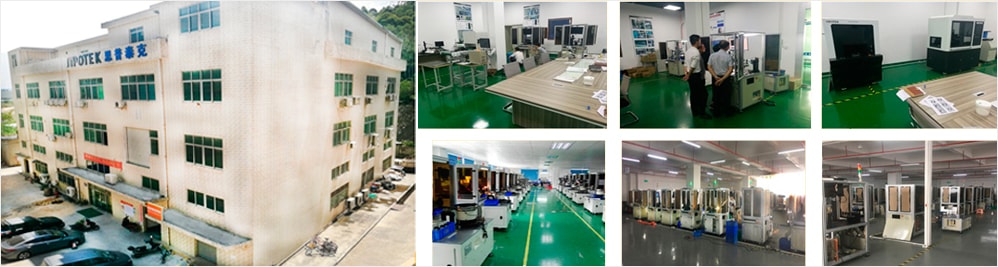
Started in 2002, Sipotek Technology is located in Shenzhen in China. The company designs and manufactures visual inspection systems with its avant-garde R&D department and a great experience in artificial vision technologies. The Sipotek Technology staff supports customers 360 degrees, from listening to their requests to the development of ambitious machines for quality control.
The complexity and miniaturization of many electronic and technological materials today is growing, and requires new production processes that accompany these technological changes.
The automated optical inspection machine automatically inspects the products that leave the surface assembly production line, detecting the presence, absence, and type and welding of the electronic components mounted on the plate, automatically finding defects that would otherwise go unnoticed. . For this reason a large number of companies seek to buy this machine and the company Sipotek is responsible for the creation of these machines
Sipotek is a company that was created in China and has more than 15 years of experience in the industry of visual inspection machines, but decided to innovate and also create automated optical inspection machine. This company is in charge of the elaboration of automated inspection machines of first quality. This company is considered a pioneer company and one of the most influential companies in the development of automated optical inspection machines. This is because it creates modern machines, easy to use, with the best technology and also with the best pieces that the market can offer.
It is an optical inspection machine that has an innovative design, besides that it is easy to use and is simple to use, which allows the operator to learn to use it in a few minutes. It is one of the most complete models that the Sipotek Company has; this is because it has detection indicators of up to 300 per minute.
Free shipping coupon code: “freeshipping” on any order from sipotek.net
Features
Main functions: leak detection, displacement, angle, position displacement, burrs Suitable for all types of die-cutting and shaving, Allows prints less than 150mm Wide range of personalization Easy to use Very complete machine Automatic coil The highest precision can reach 0.25mm Detection efficiency: up to 300-1000 CM / min
It is an optical inspection machine that has a very elegant design as it comes in a table and is easily transportable, like other models is very easy to use and allows the user to learn quickly to use it
Features As operators frequently alternate their views of the magnified image of the object, the need to adjust the focus is eliminated, meaning that the machine automatically adjusts the focus for the operator It allows the detection of defects such as incorrect loading, missing materials and other detection platforms. Main functions: charge detection, mixing and defects. Wide degree of application in different industries The highest precision can reach 0.05-5mm Detection efficiency: up to 1 second per beat
This machine is an important article of machinery that many companies around the world should enjoy; this is why the company Sipotek offers you a great variety and comfortable prices, since otherwise it would be inaccessible for companies because of its high cost. But this machine will allow remarkable improvements in the quality of many products that are produced under surface mounting assembly lines and thus achieve economies of scale in a competitive way.
Machine vision is the ability to use optical systems,
industrial digital cameras and graphics to process things to simulate human
vision and ideas. Automation equipment can be divided into three categories:
sensing detection, monitoring system and execution organization. Machine vision
belongs to the automatic use equipment of sensing detection. Machine vision
system has very high resolution accuracy and processing speed. It can reach or
surpass the vision ability of human eyes on many targets. It can process the
content that human body cannot perceive through infrared, ultrasound, microwave
special sensor imaging and so on. In addition, machine vision system can work
uninterruptedly, and has the advantages of objective and quantifiable imaging
targets.
Data show that the global machine vision shopping mall was
about 4.2 billion US dollars last year, an increase of 10.5% compared with the
same period last year. Among them, the United States is the world’s largest
machine vision shopping mall, accounting for 50%. China’s machine vision
industry started relatively late, but in recent years it has developed rapidly.
Last year, the size of shopping malls reached 350 million US dollars, with an
increase rate of about 22.2%. The Organization estimates that in the next few
years, China’s machine vision industry will maintain a 20% growth rate, far
higher than the global average of 8.4%.
From the point of view of product use, machine vision is not
only used as a single product in the field of quality detection, but also
widely installed in industrial robots, CNC machine tools and other industrial
automation products. It belongs to the upstream central link of automation
engineering and is widely used in the process of industrial automation.
Last year, our machine vision system was mainly used in the
field of electronic production, accounting for about 46%. In addition, 10.9% of
cars and 9.7% of pharmaceuticals were used. China’s machine vision skills are
becoming more sophisticated, and the scope of future use will gradually expand.
The occupational needs of food, packaging, printing, logistics, instrumentation
and other industries are expected to significantly improve.
Industrial robots. Machine vision brings good news for
obstacle avoidance and navigation of industrial robots. The human eye in the
industrial production line can not satisfy the requirements of industrial
promotion in terms of accuracy and power. As for the products which can not
observe objects and have high precision, only rely on machine vision. With the
rapid addition of industrial robotic shopping malls and the continuous
improvement of production accuracy, machine vision skills have been successfully
used in industrial robots and become a central key skill.
Medical robots. It is estimated that the combined growth
rate of global medical robots sales in the next three years is about 55%, and
the compound addition rate of surgical robots and recovery robots will reach
30% and 47% in the next five years. It can be seen that both medical robots and
industrial robots have huge shopping mall space to wait for excavation, and
machine vision adds thrust.
UAV category. Machine vision is the primary problem for UAV
to complete unmanned. Analytical think tank believes that the smart UAV will
insist on exceeding 50% in the next few years, exceeding 10 billion yuan in
2018. In addition, Tesla and time-sharing lease add new popularity for
automatic control, and machine vision benefits.
Security category. Intelligent security is an important part
of China’s smart city. Machine vision can accomplish intelligent supervision
through biological identification, intelligent event analysis and terahertz
skills. It liberates a lot of human resources and greatly improves power,
making it possible to climb the sky and see through the eyes.
At that time, machine vision has been successfully used in
industrial robots, automatic control, medical diagnosis, security monitoring and
industrial testing and other fields. With the emergence of new skills in the
science and technology industry, the window of the use of machine vision will
be opened. In the future, this use of skills will be extended to consumer
electronics, wearable equipment, advanced car control assistant system,
intelligent monitoring and other areas closer to the people’s day, as well as
the hottest new occupations at that time.



 Sipotek Visual Inspection Machine